Mörk Borg - Review
From a solo player perspective

Welcome, solo adventurers. Today I’m going to talk about the TTRPG Mörk Borg.
This post will be followed by playthroughs, so if you’re interested in reading those, please consider subscribing.
You can find an index with the links for the adventures here.
Name: Mörk Borg
Creator: Pelle Nilsson, Johan Nohr
Publisher: Free League Publishing
Players: Multiplayer, but possible to play solo
Where to find it: Mörk Borg page, DriveThruRPG, game stores
A doom metal album of a game. A spiked flail to the face. Rules light, heavy, everything else.
This is quite a well-known game in the TTRPG community, and from what I heard and read about, I felt extremely curious and wanted to try it. Not just that, but I had seen some pictures of the book, and I’m a sucker for good design and illustrations; therefore, this was on my Wishlist for quite some time. Fortunately, Santa heard me (or my husband did), and last Christmas I was offered the core book. And me being me, I may have bought a set of dice and a fountain pen to go with it, but that’s another story. Let’s get on with this review, then.
The book
Before starting with the game itself, let me talk about the book. I really have to talk about the book. Even if you’re not into this genre of TTRPG, if you happen to see the core book in a shop, please grab it and go through its pages. Really, just do it!
It’s my honest opinion that the design and print of this book are amazing.
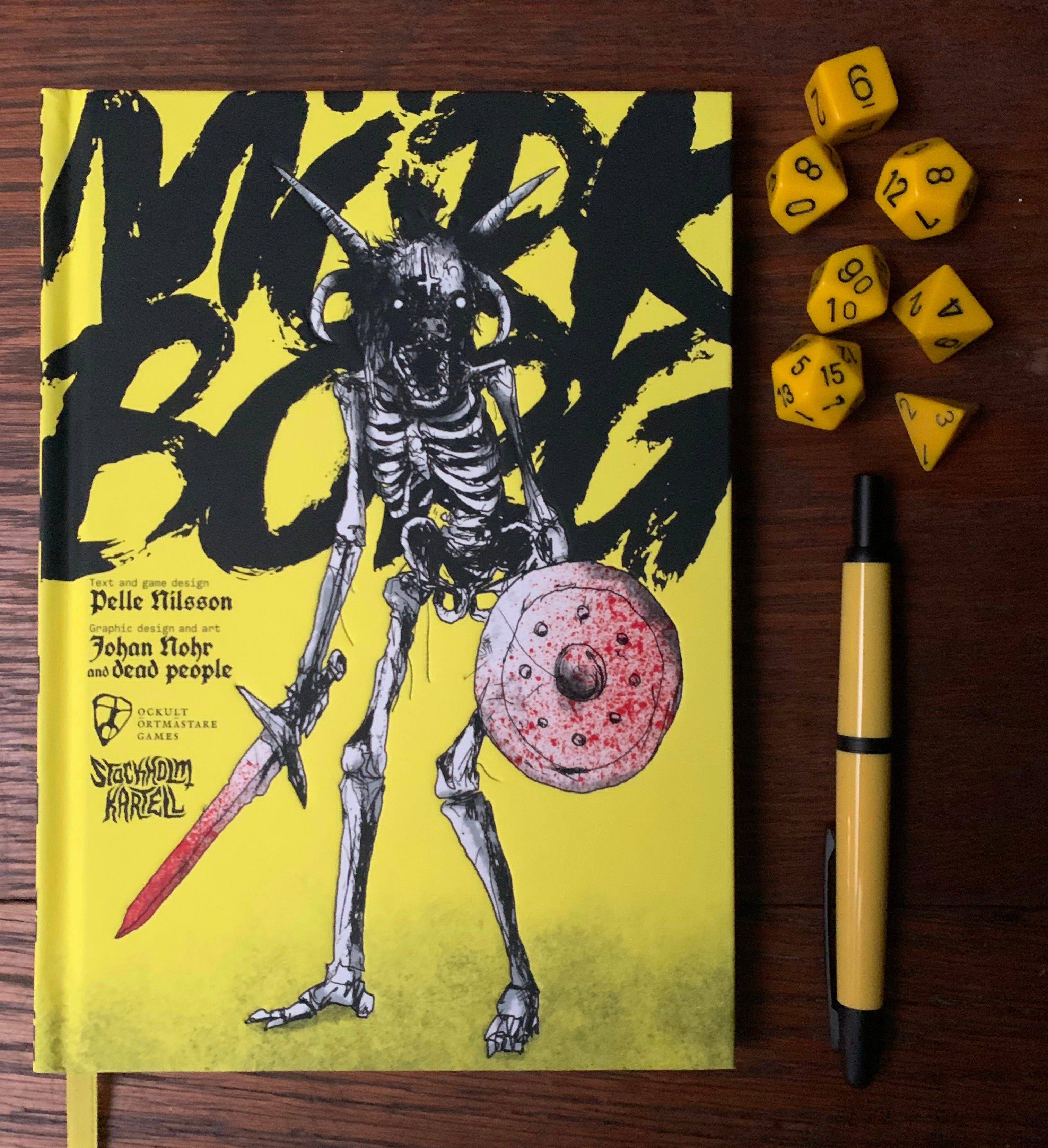
Even before opening it, the book has a hard cover with a soft velvety feel to it. In its front, there’s an illustration of a skeleton creature, which is embossed and is holding a shield that is not only embossed but also glossy. On the side, we can read the words Mörk Bork in black, but between each of these letters, other almost invisible, clear but glossy letters say “Psalm VII” (a detail from the lore of this game).
We open the book, and the images and text with different fonts, styles, and compositions are a feast for the eyes. The paper is high quality, quite thick, and most of it has a satin finish; some pages have embossed details as well, and the last part with a dungeon crawl has a more rough matt paper. Besides all that, there’s also a bookmark with print. And if you have the book and have never seen it under UV light, try it. It’s great how some details and text really pop up.
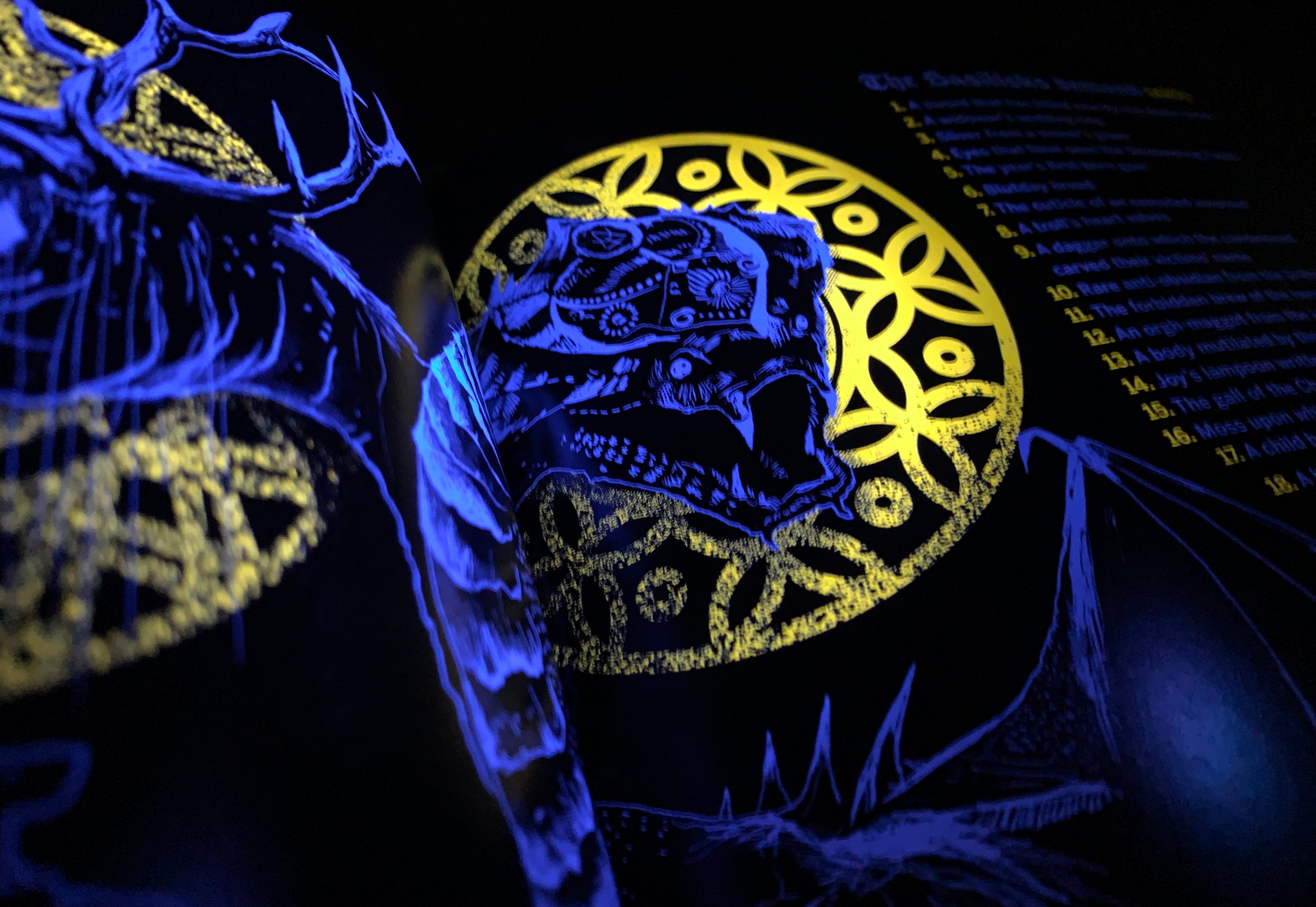
For me, this book is a work of art, but I get it, not everyone can read gothic fonts easily, and it can be confusing to read some pages. But that’s no excuse not to get this game, because if you want to read a plain text version of it, you can... and for free... even if you didn’t buy the book. That’s right! You read it correctly. If you go to the official Mörk Bork website, you can get the Bare Bones edition, a pdf with everything from the core book, except the amazing design and pictures. Not just that, but you can also get some supplements for free. This being said, I really recommend getting the physical book, even if it’s just to look good on a shelf; it’s worth it.
The game
Before starting the review of the game itself, I want to remind you that I’m looking at this game from a solo player perspective, so some things may be different when playing with a group and a GM.
In general, the mechanics of the game are quite simple, and I feel a lot is left to the GM’s judgment when playing the game. To play, you only need a set of dice (d4, d6, d8, d10, d20, d100), but it’s good to have an extra d6, since several rolls use 2d6 or d66. If you are using the Solitary Defilement to play solo, it’s also a good idea to have an extra d20, since many moves rely on 2d20.
One aspect of this system that is quite simplified is the characters’ stats and abilities/skills. The abilities are just four: agility, presence, strength, and toughness. They range from -3 to +3, and you basically use them for all the tests.
The hit points (except when playing specific classes) are equal to the toughness + d8, which means you may end up with a character that only has 1 single hit point. Good luck making it far with them, but even if your character has the highest hit points, take my advice and don’t get attached to them. More about that later.
Besides the hit points and abilities, you only have to keep track of your equipment, silver, omens, and powers. Equipment and silver are pretty obvious; you may only carry a certain number of items, and the silver is, of course, how much money you have.
Omens can be interpreted as your luck, or maybe, as they put it in the book, “the eyes of Other powers are upon you, Eldritch watchers or the Fates of alternate worlds.” Basically, you can use each omen to do one of 5 things: reroll a dice; deal maximum damage; lower damage dealt to you; neutralize a crit or fumble (20 or 1 in a d20); or lower a test’s difficulty rating. You lose omens as you use them, but you can restore them (or some) if your character manages to have a good, long rest.
The powers correspond to the magic of this universe, and they work through scrolls. If your character has a scroll, they can try to use its power, but they may only do it a certain number of times per day, and it’s possible that they try and fail, with severe consequences.
Severe consequences are a real thing with this game. The Mörk Bork world is not your friend. Every NPC may be a potential enemy, but at the same time, you’d better not jump into combat immediately, as it’s quite easy to get killed. In my first game, for example, my character died on their first encounter.
Also, in terms of survival, your character doesn’t run on air alone. They must eat and drink, and if they don’t, they can’t restore HP points. After two days of starvation, they will start to lose HP. To stock on food again, they may have to forage or hunt, but, as you probably guessed, hunting also means fighting creatures. If during any part of the game, you reach 0 HP, there’s still a chance that your character survives, although probably mutilated somehow, or slowly bleeding to death, but if you have negative HP, well, that’s it, GAME OVER.
Because it’s so easy to lose characters, many players find a way to bring a new character to the story and continue the first one’s adventure.
And as if everything being a potential danger wasn’t enough, the world itself is against you. The world is ending, and every day that passes, it gets closer to its end, so if you have a long campaign, you’d better pray to the gods of dice, or Nechrubel, that there is enough time for you to reach your goal.
You understand now why this game is described as “A spiked flail to the face”?
My opinion
Well, I said it before when I talked about the physical book: I absolutely love the core book, and there’s nothing I can add about that.
About the way the rules are written, maybe I have something to say, but it’s more remarks than criticisms.
As I mentioned, having trouble reading the fonts and composition used in the book is not a problem, since it’s possible to read everything in the bare bones edition, but some parts of the rules are so simplified that you wonder what to do with them or if you understood them correctly.
I suppose the book is written like that to give more freedom to the GM and players, but I found myself searching for playthroughs, so I could understand, or confirm how some things were done. And still, some parts are totally up to the GM to use or not, or how to use, for example, there’s a page in the book with a table titled “The Basilisks Demand”, and that’s it. There’s nothing that mentions what to do with this table. I guess that it is just a table that could inspire an adventure, or be used in case the players actually manage to meet one of the Basilisks, but that’s not stated anywhere.
Other things that are missing from the core book are actual information on how to travel between cities, do dungeon crawls, or hunt/forage for food. And along those lines, enter the supplements.
Supplements
Because of the Third Party License, there’s a plethora of supplements for Mörk Borg, and many are free. Playing solo or not, one that I believe should be bought along with the core book is Feretory. This booklet complements and enriches the core in many ways. In it, you can find the missing information on traveling, hunting (what creatures you can hunt and how much food they give you), extra tables for trinkets and special objects, character classes, and scenarios for adventures.
But before you think they are just making you pay more money for extra books, by leaving some info out of the core book, all the important information that you really need to play is for FREE on their website. Even from the Feretory.
Also on the website morkborg.exlibrisrpg.com, you can find a directory of content, tools, and resources for the Mörk Borg RPG, and there are plenty. For instance, there’s a webpage that automatically creates dungeons, and because it’s so easy to lose characters, there’s also one that randomly creates characters or you.
The Mörk Borg universe outside the core book is vast and is worth exploring.
When it comes specifically to solo play, there are two supplements that I recommend. You may use just one of them, but I actually use them both. These are Solitary Defilement and Reclvse. I found the Solitary Defilement rules for playing solo easy to follow and understand, and the Reclvse also has simple rules, although more elaborate in some ways, but it has an amazing array of tables to help you define dungeons, cities, NPCs...
These are not for free, and Reclvse is still a work in progress, but they are not expensive, and I think their creators did a great job and should have our support, so if you think of playing Mörk Borg solo, go check these out.
Final thoughts
The only thing I could point out is that the core book could have a bit more information, but since that information is available for free on their website, that is not an issue for me. And the excellent design compensates for that.
And honestly, the official supplements keep up with the great design, so I don’t mind getting some extra booklets.
The game itself is simple and entertaining. It’s a dark setting where there are corpses and mutilated bodies among other things, so, understandably, it’s not for everyone, but if you enjoy the genre, this is quite an exciting game to play. I feel that it took me to “the old days” (look at me sounding like a granny) when I played computer games in hard mode without save games; your character will likely die, and you know it, but you really want to make it through with them.
One last note that I have to reinforce is that this is a game system made for multiplayer with a GM, but thanks to its simplicity and all the amazing supplements made by fans, this is a game that works really well for solo play.
So, I definitely give it a thumbs up. If you like the genre, try it out, and remember, you can even try it for free before making the decision to buy the books.
If you enjoyed this review, consider subscribing to my Substack.
Until next time, may the dice be ever in your favour.